![sudo[freedom].org](https://sudofreedom.org/content/images/2025/08/sudo.png)
Windows Users Revolt: "Nobody Wants This"
![sudo[freedom]](/content/images/size/w160/2025/08/square.svg)
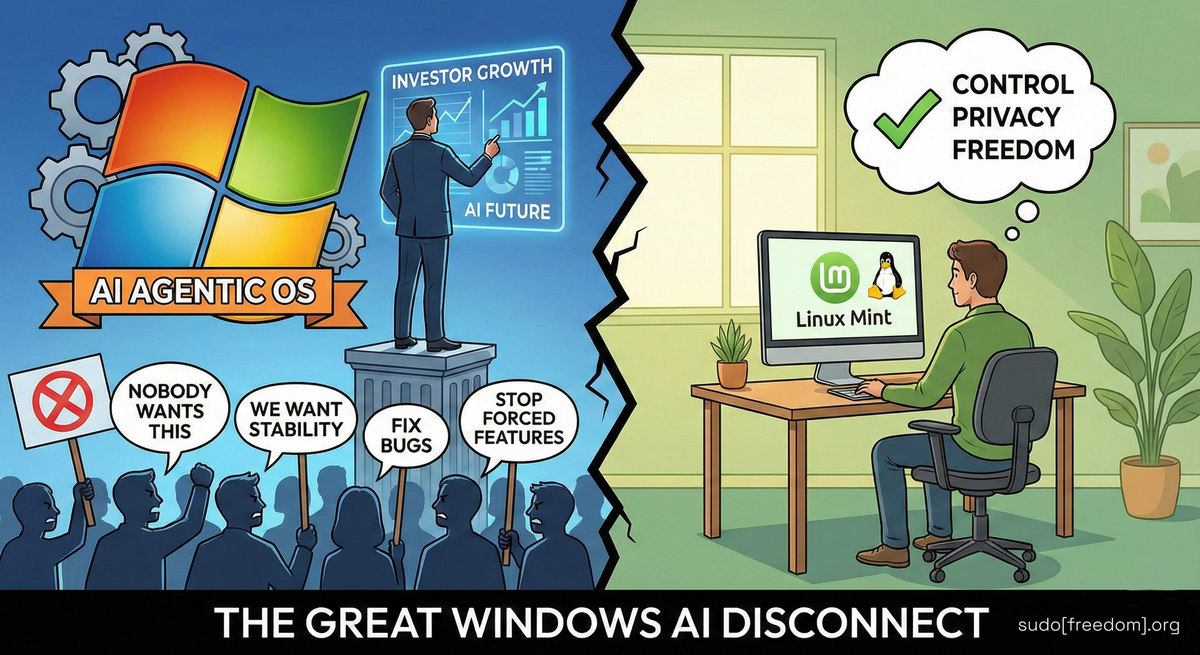
Microsoft's head of Windows thought he was sharing exciting news. Instead, he got destroyed in the replies.
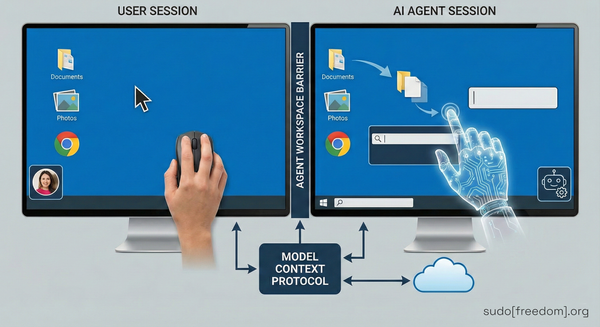
Pavan Davuluri, Microsoft's President of Windows and Devices, posted on social media last month promoting Windows' evolution into an "agentic OS." He wanted to show how companies are using Windows as an AI platform.
The response was immediate and brutal.
"You are getting overwhelmingly negative feedback about all this AI stuff. And yet you persevere. Why?"
"Straight up, nobody wants this."
"No one wants this. We want stability, performance, and bug fixes."
Hundreds of replies. Almost all negative. Some angry. Many just exhausted.
This is not a small vocal minority. This is what happens when a company loses touch with the people who actually use their product.
What Users Are Actually Saying
The complaints are consistent across Reddit, tech forums, and social media.
Users want Windows to stop adding features and start fixing problems.
They want an operating system that works reliably. That does not break with every update. That does not consume system resources running background processes nobody asked for.
They want performance improvements. Faster boot times. Less memory usage. Fewer bugs.
They want consistency. Dialog boxes that look like they belong in the same decade. Settings that exist in one place instead of scattered between Control Panel and Settings app.
They want control. The ability to disable features they do not use. Updates they can schedule instead of forced restarts. An operating system that respects their choices.
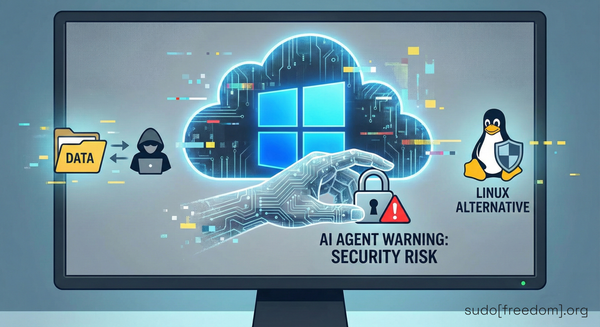
What they do not want is AI watching everything they do.
Microsoft's Response: We Hear You, But
Five days after his original post, Davuluri responded to the backlash.
"I've read through the comments and see focus on things like reliability, performance, ease of use, and more. We know we have work to do on the experience, both on the everyday usability, from inconsistent dialogs to power user experiences."
That sounds reasonable until you realize what he did not say.
He did not say Microsoft would stop pushing AI features. He did not say they would prioritize stability over new capabilities. He did not say they would listen to what users actually want.
He acknowledged the feedback. Then Microsoft kept building the agentic OS anyway.
The Windows Insider preview with experimental agentic AI features rolled out the same week.
The Disconnect Is Complete
Microsoft is operating in a different reality than its users.
Microsoft sees AI as the future of computing. They see agentic systems as revolutionary. They see themselves competing with Google and Apple in an AI race they cannot afford to lose.
Users see an operating system that gets worse with every update. They see forced features nobody asked for. They see a company that collects their data, shows them ads in an OS they paid for, and ignores their complaints.
Former Microsoft engineer Dave Plummer recently spoke about this disconnect. He worked on Windows for years. He built features people still use today. And even he says Microsoft has lost its way.
The company is chasing AI trends instead of building a stable, reliable operating system. They are adding complexity instead of removing it. They are taking control away from users instead of giving them more.
Why Microsoft Cannot Stop
Microsoft has invested tens of billions of dollars into AI. They have partnerships with OpenAI. They have built entire infrastructure around AI services. They have promised investors that AI will drive their future growth.
They cannot back down now. Not because users want AI. Because the company needs AI to justify its investments and compete in the market.
This is not about making Windows better for users. This is about Microsoft's position in the AI industry.
When a company's business strategy conflicts with user needs, the business strategy wins. Every time.
What the Backlash Reveals
The reaction to Davuluri's post shows something important. Windows users are fed up.
They tolerated telemetry. They accepted forced updates. They dealt with Cortana, then Copilot, then Recall. They adapted to changes they did not want and features they did not need.
But this agentic OS push might be the breaking point.
Users are not just complaining. They are talking about alternatives. Linux gets mentioned in nearly every thread about Windows' AI features. MacOS comes up as an option people are seriously considering.
The comments include people saying they are already in the process of switching. Setting up dual boot systems. Testing their software on Linux. Planning their migration away from Windows.
Microsoft's AI push is not winning users. It is driving them away.
The Pattern Across Windows 11
This backlash is not isolated. It fits a pattern of Microsoft ignoring user feedback.
Windows 11 launched with a taskbar that removed features Windows 10 users relied on. No explanation. Just removed. Users complained for months. Microsoft eventually added some features back but never fully restored the functionality.
Windows 11 made it harder to use local accounts. The setup process pushes users toward Microsoft accounts with dark patterns and hidden options. Users complained. Microsoft made it even harder in later updates.
Windows 11 added widgets nobody asked for. Ads in the Start menu. Recommendations for apps users did not want. Edge browser integration that users cannot fully remove.
Each time, users complained. Each time, Microsoft proceeded anyway.
The agentic OS is just the latest example of Microsoft building what serves their business interests instead of what serves their users.
Where This Goes Next
Microsoft will continue building AI into Windows. They have made that clear.
The experimental agentic features in Windows Insiders will become standard features in future updates. AI agents will gain more capabilities and deeper system integration. The features will move from opt-in to opt-out to enabled by default.
This is how Microsoft operates. Test features with Insiders. Roll them out to stable releases. Make them harder to disable over time.
Users who want a different direction have two options.
Stay on Windows and accept what Microsoft builds. Keep disabling features as they appear. Keep searching for registry tweaks to turn off telemetry. Keep hoping Microsoft eventually listens.
Or leave Windows entirely.
The Real Alternative
Linux based operating systems give you an operating system built by a community that actually listens to users.
When Linux users said they did not want Snap packages forced on them, community distrobutions, like the Linux Mint team removed Snap integration from the system. Completely. Because users did not want it.
When users asked for better update management, Linux Mint built an update manager that gives users full control. No forced restarts. No automatic updates without permission.
When users wanted familiar layouts and interfaces, Linux Mint built Cinnamon desktop environment that looks and works like what people expect from a desktop OS.
Linux Mint exists because users wanted an alternative to Ubuntu's direction. It succeeded because it actually delivers what users ask for.
This is what happens when an operating system serves users instead of corporate strategy.
What the Backlash Means
When hundreds of people tell Microsoft "nobody wants this" and Microsoft proceeds anyway, it reveals everything you need to know about who Windows serves.
Not you. Not the people who use it every day. Not the users who pay for it.
Windows serves Microsoft's AI ambitions. Windows serves their competition with Google and Apple. Windows serves their investment in OpenAI.
You are not the customer. You are the data source.
The backlash against the agentic OS is not about resisting progress. It is about users realizing they have no voice in the direction of the platform they depend on.
Microsoft heard the feedback. They acknowledged it. Then they ignored it.
That tells you everything.
sudo[freedom].org provides complete guides for making the transition from Windows to Linux. We explain every step. We show you how to test it safely. We help you find alternatives for your Windows software.