![sudo[freedom].org](https://sudofreedom.org/content/images/2025/08/sudo.png)
Your Smart TV is Watching You (And So is Your HDMI Cable)
![sudo[freedom]](/content/images/size/w160/2025/08/square.svg)
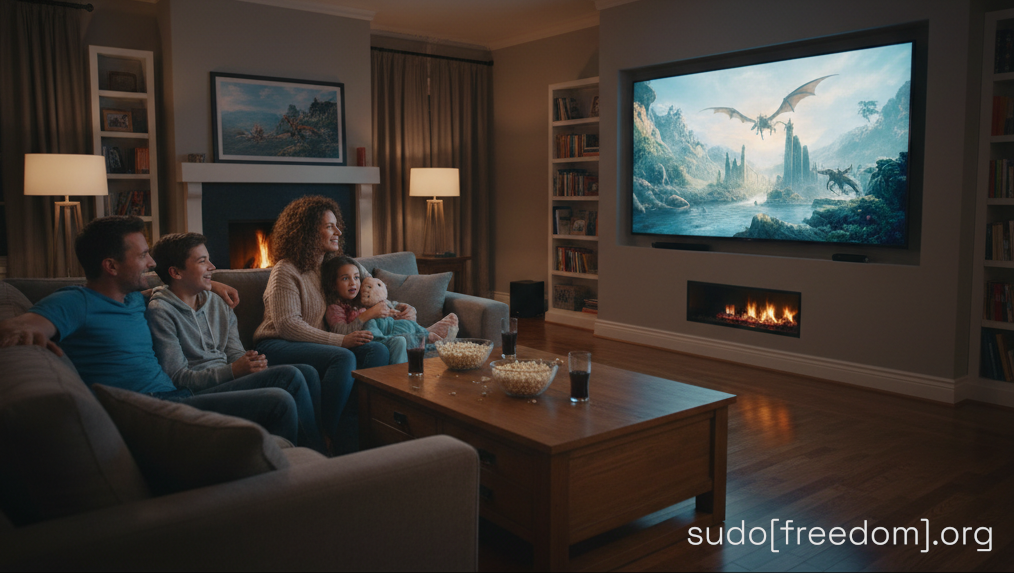
Bottom Line Up Front: Smart TVs use ACR (Automatic Content Recognition) technology to spy on everything displayed on your screen, including content from external devices like gaming consoles, Apple TVs, and PCs connected via HDMI. This data is fingerprinted, sent to servers, matched against databases, and sold to advertisers and data brokers. Even your home videos aren't safe. The solution? Disconnect your TV from the internet entirely and use external streaming devices, or better yet, switch to a computer monitor or projector that lacks smart features. Additionally, HDMI cables themselves can be compromised through electromagnetic interception, a separate but equally concerning threat for those handling sensitive information.
The Spy in Your Living Room
You bought a smart TV thinking you got a great deal. A 50-inch 4K display for $228 at Walmart. But that price isn't reflecting the actual cost of the hardware. You're paying the rest with your privacy.
These televisions are equipped with technology that monitors everything displayed on your screen, not just the apps built into the TV. This includes:
- Game consoles (PlayStation, Xbox, Nintendo Switch)
- Streaming devices (Apple TV, Roku stick, Fire TV stick)
- PCs and laptops connected via HDMI
- DVD and Blu-ray players
- Home videos streamed from your phone
- Over-the-air broadcasts from antenna
The TV doesn't care where the content comes from. If it's on the screen, it's being monitored.
How ACR Technology Works
ACR (Automatic Content Recognition) is the core technology that enables this surveillance. Here's how it operates:
The Process
1. Sampling: The TV continuously samples what's on the screen, taking visual snapshots and audio clips, sometimes multiple times per second.
2. Fingerprinting: These samples are converted into digital fingerprints, unique data patterns derived from the pixel arrangements and audio waveforms.
3. Transmission: The fingerprints are sent to remote servers owned by the TV manufacturer or third-party data brokers.
4. Matching: Servers match these fingerprints against massive databases containing movies, TV shows, games, advertisements, and other content.
5. Profile Building: Matched content is added to your household's advertising profile, noting what you watch, when you watch it, and for how long.
6. Monetization: This profile is sold to advertisers and data brokers who use it to target you with ads across all your devices, not just your TV.
The Granularity is Disturbing
Roku, the company most transparent about their ACR practices, openly advertises to potential clients that their system provides:
- Second-by-second tracking of what content viewers watch
- Complete tracking of which ads were shown and for how long
- Identification of which games are being played on connected consoles
- Duration data for every piece of content
Roku describes this level of surveillance as providing measurement that is "unprecedented." They're right.
Your Apple TV Doesn't Protect You
Many privacy-conscious users purchase devices like Apple TV, thinking they're choosing a more secure option. Apple does implement better privacy protections than most streaming platforms.
But there's a critical problem: the TV itself is still spying on what the Apple TV outputs.
The HDMI connection between your Apple TV and your smart TV is where the surveillance happens. The TV monitors the HDMI input and processes everything coming through that cable, regardless of whether it's from an Apple TV, gaming console, or computer.
This means Apple's privacy protections are completely bypassed. The TV doesn't need to know what app you're using or what account you're logged into. It just needs to see what's on the screen.
The Business Model: Why Your TV is So Cheap
Roku's third quarter 2024 financial results reveal the truth about modern smart TV economics:
- Platform revenue (advertising and data sales): Over $1 billion in gross profit
- Hardware revenue: $146 million
Hardware sales are an afterthought. The TV is just the delivery mechanism for the actual product: you and your data.
This is why manufacturers can sell 50-inch 4K TVs for under $250. They're not making money on the hardware. They're making it back by selling everything you watch to data brokers and advertisers. The TV pays for itself, from their perspective, within months of your purchase.
Every manufacturer operates this way. Samsung, LG, Vizio, Hisense, TCL, and others all employ similar ACR systems. Some are more transparent about it than others, but the core practice is universal.
AI Profile Building: Beyond Simple Tracking
Current ACR systems send fingerprints to servers for matching. But as AI capabilities improve, the next evolution is obvious: full image and audio capture for detailed AI analysis.
Lightweight AI models can already run on smartphones and analyze photos to build detailed profiles. Researchers testing these systems found that an AI model running locally on an iPhone could analyze a single photo of a child and generate:
- Age range estimates
- Activity patterns
- Product recommendations
- Compatible advertiser suggestions
This technology is too lucrative for TV manufacturers to ignore. Once one company decides to deploy full AI analysis of screen content instead of just fingerprinting, the others will follow.
Your home videos, your video calls, your work documents displayed on screen, all of it becomes training data and advertising intelligence.
The Opt-Out Illusion
TV manufacturers claim ACR is an opt-in feature. This is technically true but practically false.
The Setup Trap
When you first turn on a Roku TV, it displays a QR code. You scan it with your phone, log into your Roku account, and immediately face the ACR question. But look at the options:
- Agree (large, prominent button)
- Manage preferences (smaller, less obvious)
There's no clear "disagree" or "no" option. Most users, excited to use their new TV, click agree without thinking.
If you click manage preferences, you can then find the option to disagree. But how many people actually do this? Very few.
What Happens When You Actually Opt Out
LG takes a different approach. When you opt out of ACR on an LG TV, it disables all smart TV functions. You can't use any of the built-in apps. The TV still works with external devices, but the smart features are completely locked until you agree to the data collection.
Samsung uses ambiguous language, burying ACR disclosures deep in privacy policies without clear explanations of what's being collected or how it's used.
When Users Get a Real Choice
Apple implemented app tracking transparency on iOS, giving users a clear binary choice:
- Ask app not to track (no)
- Allow (yes)
When users are given this clear choice, 96% of US users initially opted out. More recent data suggests opt-out rates remain between 70-85%.
This proves that when presented with clear options, most people choose privacy. TV manufacturers know this, which is why they design their opt-out processes to be confusing and punishing.
Why Most People Don't Disconnect Their TVs
The obvious solution is to disconnect your smart TV from the internet entirely. But most consumers don't do this.
The primary reason people buy smart TVs is for the built-in apps. Walking into a store, the main purchase decision for lower and mid-range TVs is whether it supports Netflix, Disney Plus, YouTube, and other streaming services people use regularly.
A $228 TV at Walmart is appealing not just because of the price, but because it comes with all the apps pre-installed and ready to use. This convenience is the entire value proposition.
Disconnecting the TV from the internet means losing access to these apps, which defeats the purpose of buying a smart TV in the first place for most consumers.
This is why smart TV surveillance is so pervasive. The surveillance is built into the core functionality that people actually want.
What's Happening Right Now
Smart TV surveillance isn't just getting worse. Some of the most invasive practices are already deployed:
Full image capture is happening now. Manufacturers are moving beyond fingerprinting to capture actual screen images for detailed AI analysis. This isn't future speculation, it's current practice.
Network scanning is live. Smart TVs actively scan your home network to identify other devices and build profiles that link your TV viewing to your other machines.
Firmware updates that reset privacy settings are routine. Users who carefully opt out of data collection find their settings reverted after automatic updates, forcing them to repeatedly disable surveillance features.
One user reported their TV identifying a DVD they were watching on an offline PlayStation 3 and recommending they stream it instead. The TV was online, the PS3 wasn't. The TV was reading the HDMI feed and matching the content in real time.
This demonstrates how sophisticated ACR systems already are.
What You Can Do Right Now
Immediate Actions
1. Disconnect your TV from the internet
Turn off Wi-Fi in your TV settings. Don't connect it to Ethernet. The TV still works perfectly as a display for external devices like Apple TV, Roku sticks, gaming consoles, and computers. You lose the built-in apps, but you gain privacy.
If you really must connect it to the internet, set up a separate Wi-Fi network on your router to isolate it from the rest of your network. This prevents the TV from linking you to other machines and stops hackers from using the TV as a gateway to your home network.
2. Use external streaming devices
Apple TV offers better privacy protections than most alternatives. Roku sticks and Fire TV sticks collect data too, but they don't have ACR monitoring the HDMI feed like smart TVs do.
3. Check your current settings
If you want to keep your TV connected to the internet, go through every privacy setting and disable everything related to:
- ACR or content recognition
- Interest-based advertising
- Viewing data collection
- Smart TV experience features
Consumer Reports maintains an updated guide for opting out of ACR on major TV brands.
4. Consider non-smart alternatives
Computer monitors and commercial displays don't have smart features or ACR. They're pure displays. A monitor costs more than a smart TV of the same size, but it respects your privacy by default. Projectors are another option, especially for home theater setups.
The Future: Why This Gets Worse
Smart TV surveillance will become more invasive. AI capabilities are advancing rapidly, and the economic incentives are too strong to resist.
Expect future developments like:
- Real-time content blocking where TVs refuse to display certain content based on corporate or government pressure
- Biometric analysis using built-in cameras to track who's watching and their emotional responses
- Enhanced AI profiling that analyzes not just what you watch, but how you react to it
HDMI Cable Interception: A Separate Threat
Beyond smart TV spying, there's another concern: HDMI cables themselves can leak your data through electromagnetic signals. This is a completely separate issue from ACR surveillance, but it's equally serious for anyone handling sensitive information.
How HDMI Interception Works
HDMI cables transmit digital video signals at high frequencies. These signals generate electromagnetic radiation that leaks from the cable.
Researchers at Universidad de la República in Uruguay developed an AI model that can reconstruct digital signals from leaked electromagnetic emissions captured several meters away from the cable. The AI was trained on matching sets of original and intercepted signals, learning to recognize patterns in the electromagnetic noise.
Once trained, the AI can intercept signals and reconstruct what's on the screen with approximately 70% character accuracy, enough for humans to read most of the text correctly.
Attack Vectors
This surveillance can be executed through multiple methods:
- Planting a small device near the target computer or inside the building
- Using a directional antenna from outside the building (from a vehicle or neighboring apartment)
- Installing a device that captures signals and transmits them or stores them for later physical recovery
The NSA and NATO classify these as TEMPEST attacks, electromagnetic eavesdropping that can compromise secure communications.
Who Should Worry
Government agencies, financial institutions, and businesses handling sensitive intellectual property are the primary targets. Journalists, activists, and individuals working with confidential information also face elevated risk.
For most home users, HDMI interception is unlikely. But if you handle sensitive data regularly, especially financial information or trade secrets, the threat is real.
Protecting Against HDMI Interception
For users handling sensitive data:
- Use shielded HDMI cables designed to minimize electromagnetic leakage
- Position monitors away from windows to reduce external interception risk
- Implement physical barriers between your workspace and external walls
- Use signal filtering for high-security environments
Your Digital Life, Your Rules
You paid for your TV. It should work for you, not against you. But the current smart TV business model treats you as the product, not the customer.
The simplest solution is to disconnect your TV from the internet entirely. Use it as a display for devices you control: an Apple TV, a computer, a gaming console. Let those devices handle the streaming, and keep the TV offline.
If you need to buy a new display, consider a computer monitor or commercial display instead of a smart TV. These devices cost more because they don't subsidize the price through surveillance.
sudo[freedom].org provides practical guides for escaping digital surveillance. We'll show you how to set up secure alternatives to Big Tech services, host your own cloud storage, and build a privacy-focused digital life without drowning in technical jargon.
Your data, your rules. Your devices, your control. Your digital life, your choice.
The question isn't whether you can afford to care about privacy anymore. It's whether you can afford not to.
For step-by-step guides on protecting your privacy, visit sudo[freedom].org